

Two businesses can generate the same annual revenue and still command very different selling prices. One may have a loyal customer base, reliable earnings, and operations that run without the owner’s constant involvement. The other may depend heavily on a single client or the founder’s personal relationships to keep revenue coming in. On paper, their sales figures look similar. To a potential buyer, however, they represent very different investments.
This guide explains how business valuation services in Maryland work, which valuation methods professionals use, and what owners should consider when determining the value of a privately held company.
What Is Small Business Valuation in Maryland?
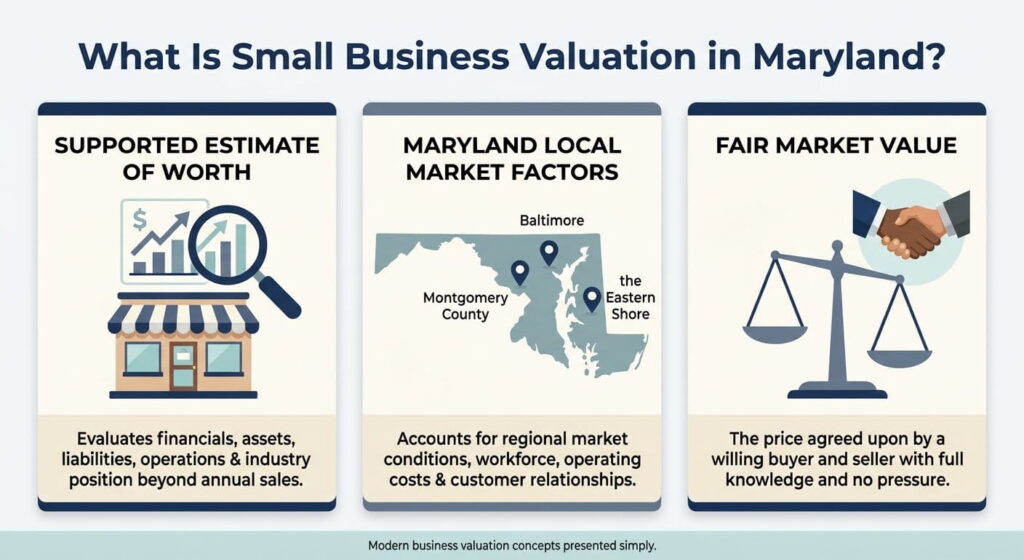
Small business valuation in Maryland is the process of estimating what a company is worth at a particular point in time. It involves examining the business’s financial performance, assets, liabilities, operations, and position within its industry. The goal is to develop a supported estimate of value rather than rely on the owner’s expectations or an informal calculation based on annual sales.
For a Maryland business, the assessment may also consider its local market, customer relationships, operating costs, workforce, and competitive position. A company serving customers in Baltimore may face different market conditions from one operating primarily in Montgomery County or the Eastern Shore. These differences can influence future earnings and the level of interest a potential buyer may have.
A valuation can also establish the fair market value of a small business. This generally refers to the price at which a business would change hands between a willing buyer and a willing seller, with neither under pressure to complete the transaction and both having reasonable knowledge of relevant facts.
How Is a Business Valued in Maryland?
The income approach estimates what a business is worth based on its ability to generate future economic benefits. It is particularly relevant for established companies with a history of earnings and reasonably predictable cash flow. There is no single formula that works for every company. The appropriate valuation method depends on the business’s financial history, industry, asset base, earnings potential, and the reason for the assessment.
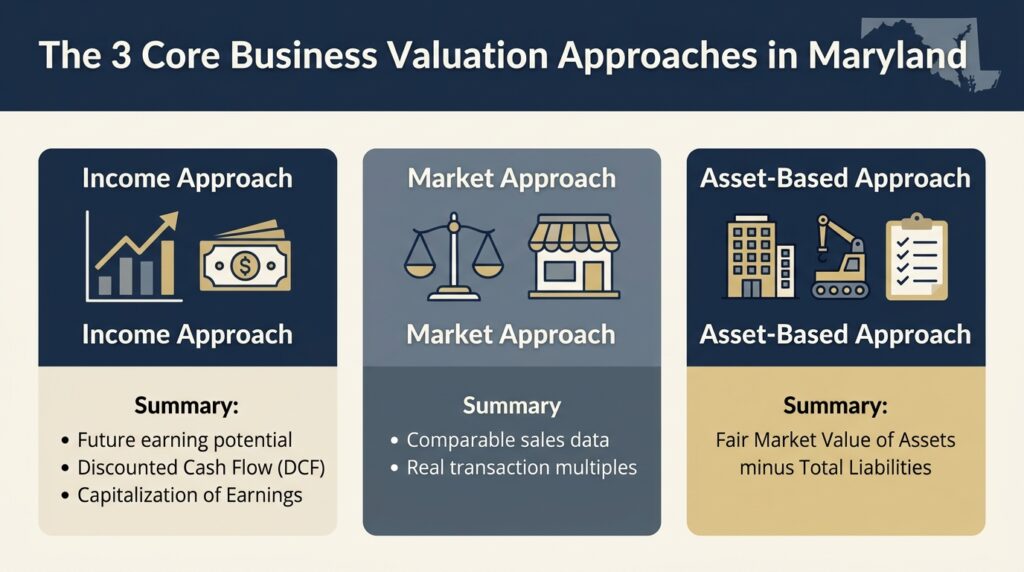
Professionals generally consider three established approaches: the income approach, the market approach, and the asset-based approach. The IRS also recognizes these three broad approaches in its business valuation guidance.
1. Income Approach
The income approach estimates what a business is worth based on its ability to generate future economic benefits. It is particularly relevant for established companies with a history of earnings and reasonably predictable cash flow. One commonly used method is discounted cash flow (DCF). It involves projecting future cash flows and converting them into their present value using a discount rate that reflects the risks associated with achieving those projections.
Another method is capitalization of earnings. This approach uses a representative level of ongoing earnings and applies a capitalization rate to estimate value. It is generally more suitable for businesses with relatively stable financial performance.
For example, a Maryland IT services company with recurring contracts may have predictable income that supports an income-based valuation. A business experiencing significant fluctuations in revenue may require more careful adjustments and a different analytical approach.
2. Market Approach
The market approach determines value by comparing the business with similar companies that have been sold or, where appropriate, publicly traded businesses in the same industry. An appraiser examines available transaction data, including selling prices and relevant financial measures. These comparisons may help establish valuation multiples based on earnings or revenue.
To determine business valuation for privately owned companies, comparable transaction data can be particularly useful. However, finding genuinely comparable businesses is not always easy. Differences in company size, location, profitability, customer concentration, and operating structure can make a direct comparison misleading. Actual transaction prices generally provide stronger evidence than advertised asking prices, which may not reflect what buyers ultimately paid.
3. Asset-Based Approach
The asset-based approach calculates value by assessing the company’s assets and subtracting its liabilities. Depending on the business, this may include property, equipment, inventory, vehicles, cash, and certain intangible assets. An adjusted net asset method estimates the current value of assets and liabilities rather than relying entirely on their historical book values. A liquidation approach, by comparison, estimates what could be recovered by selling the assets, typically when the business is closing or no longer expected to operate as a going concern.
This method may be particularly relevant for manufacturing companies, equipment-heavy operations, and businesses whose assets represent a substantial portion of their overall value.
Factors Affecting Small Business Valuation
A company’s financial statements provide an important starting point, but they rarely tell the entire story. Two businesses with similar profits may receive different valuations because of differences in their operations, risk exposure, and ability to maintain performance after a change in ownership.
The following factors can influence the outcome of a small business appraisal services in Maryland.
Revenue and Profitability
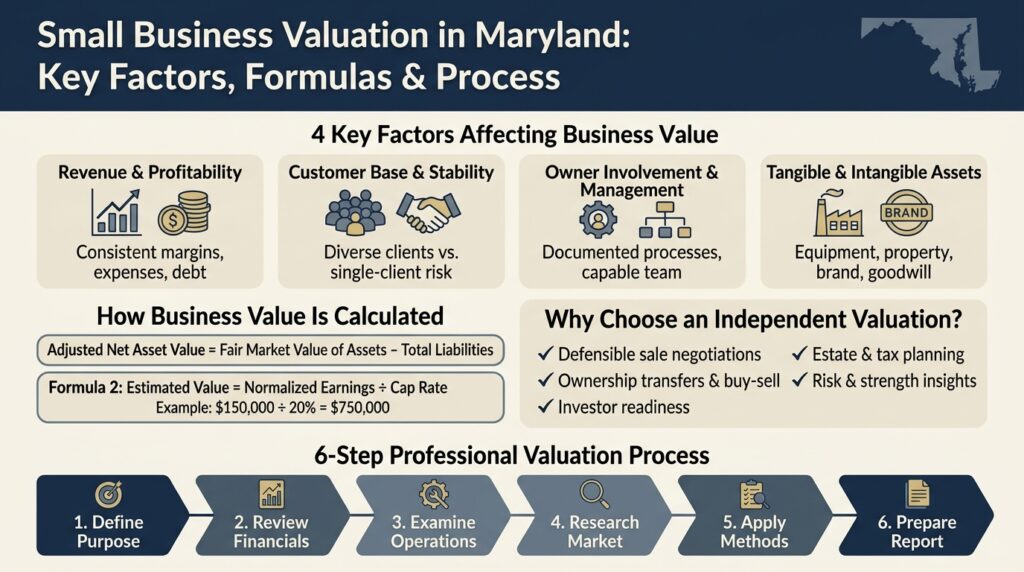
Consistent revenue and healthy profit margins generally make a business more attractive to buyers. However, appraisers look beyond total sales to understand how much income the company actually generates. Operating expenses, owner compensation, debt obligations, and unusual one-time costs can all affect the earnings figure used in a valuation.
Customer Base and Contract Stability
A business that relies on one major customer faces a different level of risk from one serving hundreds of regular clients. Long-term agreements, repeat purchases, and established customer relationships can support more predictable revenue. Customer concentration, on the other hand, may raise concerns about how much business will remain after an ownership change.
Owner Involvement and Management Structure
If the owner handles most sales, manages daily operations, and maintains important client relationships, transferring the business may become difficult. A company with documented processes and capable employees may be easier for a new owner to operate. The extent of owner dependence can therefore influence perceived risk and value.
Tangible and Intangible Assets
Property, machinery, inventory, vehicles, and equipment contribute to a company’s asset base. Intangible assets can also matter, including trademarks, proprietary systems, customer lists, established brand recognition, and goodwill. Their relevance depends on whether they generate measurable economic benefits and can transfer to a new owner.
How Is the Value of a Small Business Calculated?
Business owners can perform preliminary calculations to get a general idea of their company’s financial position. However, these estimates should not be confused with a formal valuation.
One starting point is to calculate adjusted net assets:
Adjusted Net Asset Value = Fair Market Value of Assets − Total Liabilities
For an income-based estimate, an appraiser may use normalized earnings and an appropriate capitalization rate:
Estimated Business Value = Normalized Annual Earnings ÷ Capitalization Rate
For example, if a business generates normalized annual earnings of $150,000 and an appropriate capitalization rate is 20%, the calculation produces an indicated value of $750,000. This is a simplified illustration, not a universal valuation formula. The earnings measure, capitalization rate, ownership interest, and other assumptions must be appropriate for the assignment.
Why Choose an Independent Business Valuation in Maryland?
An independent business valuation in Maryland provides an objective assessment without relying solely on the owner’s expectations or a prospective buyer’s offer. This distinction becomes particularly important during negotiations, partnership changes, and other situations where different parties may have competing financial interests.
An independent assessment can also help with:
- Establishing a defensible starting point for sale negotiations.
- Supporting ownership transfers and buy-sell arrangements.
- Reviewing financial information before bringing in investors.
- Providing documentation for estate and tax-related planning.
- Understanding the company’s strengths and financial risks.
What to Expect from Professional Small Company Valuation Services
A professional valuation involves considerably more than reviewing a profit and loss statement. The appraiser needs enough information to understand how the company operates, where its income comes from, and what could affect its future performance.
A typical engagement may involve the following steps:
- Understanding the purpose
- Reviewing financial records
- Examining business operations
- Researching market conditions
- Applying valuation methods
- Preparing the report
Business Valuation for Maryland Business Owners: Getting Started
A business valuation should reflect the company’s actual financial position, not simply what its owner hopes to receive from a sale. If you are considering a sale, planning an ownership transition, or need an independent assessment, Grant & Associates can help you evaluate your company’s financial position.
Visit our Business Valuation Services page to learn more or contact the firm to discuss your requirements.
Frequently asked questions
Q.01When Should A Small Business Owner Get A Professional Valuation?
A business owner should consider a professional valuation before selling the company, transferring ownership, bringing in investors, or resolving a partnership dispute. It can also support retirement, estate, and succession planning. Obtaining an assessment before a major transaction gives owners time to address financial weaknesses and prepare supporting documentation.
Q.02How Is A Small Business Valued In Maryland?
A small business is generally valued using the income, market, or asset-based approach. The appraiser examines financial performance, assets, liabilities, industry conditions, and comparable transactions. The appropriate method depends on the company’s operations, available financial information, and the purpose of the valuation.
Q.03What Are The Three Main Business Valuation Methods?
The three main approaches are the income approach, market approach, and asset-based approach. The income approach considers future earning potential, the market approach compares similar business transactions, and the asset-based approach calculates the value of assets after deducting liabilities.
Q.04What Factors Affect The Value Of A Small Business?
Profitability, revenue consistency, customer relationships, management structure, industry conditions, debt, and tangible and intangible assets can all influence business value. The company’s dependence on its owner and its ability to maintain earnings under new ownership may also affect the final assessment.
Q.05Does Annual Revenue Determine Business Value?
No. Annual revenue indicates total sales but does not account for operating expenses, profitability, debt, or future earning potential. A company with lower revenue but stronger margins and consistent cash flow may be worth more than a larger business with weaker financial performance.
About the author
Robert E. Grant
Founder, Grant & Associates, LLC
Robert has helped Maryland business owners and families with accounting, payroll and tax since 1994. He writes in plain English about what to do, what to avoid, and when to call for help, drawing on three decades of real client files.