
Managing business finances can feel like navigating a maze of receipts, invoices, tax rules, and reports. To resolve these challenges, many business owners turn to bookkeeping and accounting services in Maryland, thinking both are the same thing, but they’re not.
Understanding the distinction is essential for making informed decisions, staying compliant, and improving profitability. This confusion often leads business owners to either underinvest in financial management or rely on the wrong kind of support at the wrong stage of growth.
For example, some businesses assume software alone can replace financial expertise, while others hire advanced accounting help before their basic records are even properly organized. In reality, bookkeeping and accounting work best as a connected system—one capturing accurate day-to-day data, and the other transforming that data into meaningful insight for planning, tax strategy, and long-term growth.
By the end of this guide, you’ll have a clear understanding of how each function works, where they overlap, and how to decide which one your business actually needs.
Bookkeeping Basics for Small Businesses
Bookkeeping is the foundation of financial management. It focuses on the systematic recording of financial transactions. Every time money moves in or out of your business, bookkeeping ensures it is accurately documented.
Understanding bookkeeping basics for small businesses is essential because it provides the structure needed to track income, expenses, invoices, and payments consistently. Without these basics in place, it becomes difficult to measure performance or prepare reliable financial reports later on.
At its core, bookkeeping involves:
- Recording sales and revenue
- Tracking expenses and bills
- Managing invoices and receipts
- Reconciling bank statements
- Maintaining ledgers and financial records
For small businesses, bookkeeping is often a daily or weekly task. It is not about interpreting financial data or giving strategic advice—it is about ensuring the raw data is accurate and organized. Think of bookkeeping as building the structure of a house. If the foundation is weak or messy, everything built on top becomes unreliable.
Modern bookkeeping is often done using software such as QuickBooks, Xero, or similar platforms. However, the tool is only as good as the consistency and accuracy of the person using it.
Accounting Fundamentals for Beginners
Accounting builds on bookkeeping. While bookkeeping focuses on recording transactions, accounting focuses on interpreting, analyzing, and reporting financial data. For those looking to understand accounting basics for beginners, it’s important to start with how financial statements are prepared, among other things.
Accounting answers questions like:
- Is the business profitable?
- What is the cash flow situation?
- How much tax will be owed?
- Are financial trends improving or declining?
Key accounting tasks include:
- Preparing financial statements (income statement, balance sheet, cash flow statement)
- Tax preparation and planning
- Financial analysis and forecasting
- Budgeting and strategic planning
- Ensuring compliance with tax laws and regulations
Accounting turns raw financial data into actionable insight. If bookkeeping is building the foundation, accounting is designing and evaluating the entire structure of the business. A good accountant helps report what happened, why it happened, and what should happen next.
Bookkeeping vs Accounting: Key Differences
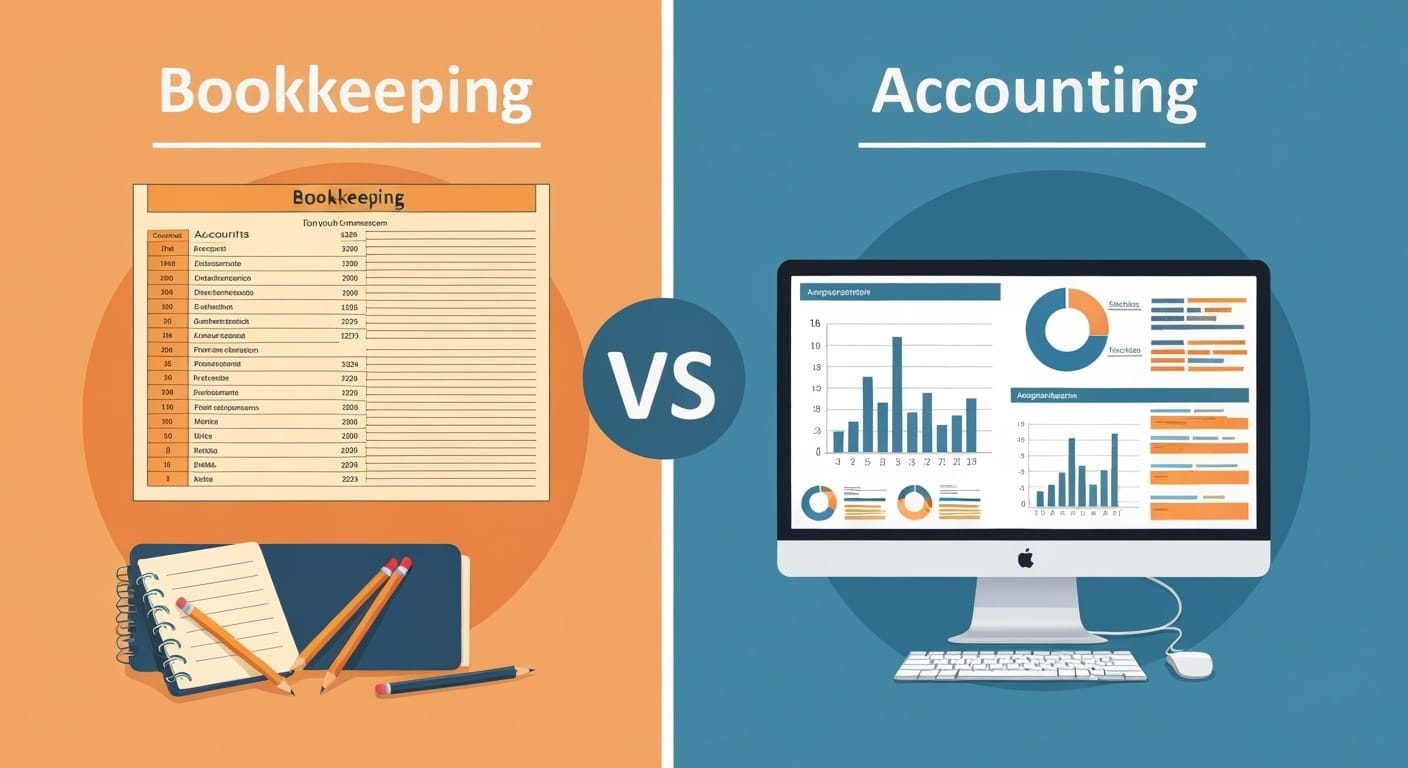
Although closely related, bookkeeping and accounting differ in scope, purpose, and complexity.
Focus
- Bookkeeping: Recording financial transactions
- Accounting: Interpreting and analyzing financial data
Skill Level
- Bookkeeping: Requires attention to detail and consistency
- Accounting: Requires financial expertise, certification, and analytical skills
Output
- Bookkeeping: Ledgers, transaction records, reconciled accounts
- Accounting: Financial statements, reports, tax filings, forecasts
Decision-Making Role
- Bookkeeping: No strategic decision-making
- Accounting: Provides insights that guide business decisions
Timing
- Bookkeeping: Ongoing, day-to-day
- Accounting: Monthly, quarterly, or annually
In simple terms: bookkeeping records the “what,” while accounting explains the “so what.”
Roles of a Bookkeeper and Accountant
What Does a Bookkeeper Do?
A bookkeeper is responsible for keeping financial records accurate and up to date. Their role is essential for maintaining financial order.
Typical responsibilities include:
- Recording daily transactions
- Issuing and tracking invoices
- Managing accounts payable and receivable
- Reconciling bank and credit card statements
- Organizing receipts and financial documentation
Maintaining general ledgers
Bookkeepers ensure that every financial movement is documented correctly and consistently. Without them, businesses risk disorganized records, missed payments, and inaccurate financial reporting.
What Does an Accountant Do?
An accountant works with the information provided by bookkeeping and turns it into meaningful financial insight.
Typical responsibilities include:
- Preparing financial statements
- Filing taxes and ensuring compliance
- Conducting financial analysis
- Creating budgets and forecasts
- Advising on financial strategy
- Identifying cost-saving opportunities
Accountants often act as advisors to business owners. They help interpret financial performance and guide long-term planning. Their work is especially important during tax season, audits, or major business decisions such as expansion or investment.
Is Bookkeeping Part of Accounting?
Yes, bookkeeping is generally considered a subset of accounting. Bookkeeping forms the first step in the accounting process. Without accurate bookkeeping, accounting cannot produce reliable financial statements or insights.
A simple way to understand it:
- Bookkeeping = data collection and organization
- Accounting = analysis, interpretation, and reporting
However, even though bookkeeping is part of accounting, the two roles are distinct in practice. Many businesses assign them to different people or systems because each requires a different skill set and focus.
Do I Need a Bookkeeper or Accountant for My Business?
This depends on the size, complexity, and financial activity of your business.
You may need a bookkeeper if:
- You have frequent daily transactions
- You struggle to keep financial records organized
- You need help managing invoices and expenses
- You want up-to-date financial tracking
- You are spending too much time on admin tasks
A bookkeeper is especially helpful for small to mid-sized businesses that need consistent recordkeeping but do not yet require advanced financial analysis.
You may need an accountant if:
- You need help with taxes and compliance
- You want financial forecasting or business planning
- Your business is growing or becoming more complex
- You need financial statements for investors or loans
- You want strategic advice for profitability
Accountants become increasingly important as a business scales or enters regulated financial environments.
In reality, many successful businesses use both roles together:
- The bookkeeper maintains accurate daily records
- The accountant uses that data to guide financial decisions
When both roles are properly aligned, business owners gain clarity, control, and confidence in their financial position.
So, Should You Hire an Accountant or a Bookkeeper?
Understanding the difference between bookkeeping and accounting directly impacts how effectively you manage your business finances. Bookkeeping ensures that your financial records are accurate and organized, while accounting transforms those records into insights that support decision-making, compliance, and long-term growth.
If your business is struggling with financial clarity or you are unsure whether your records are being handled correctly, getting professional support can make a significant difference. At Grant & Associates, LLC, we help businesses bridge the gap between day-to-day financial tracking and strategic financial planning through bookkeeping and accounting services in Maryland, ensuring both work together effectively.

