

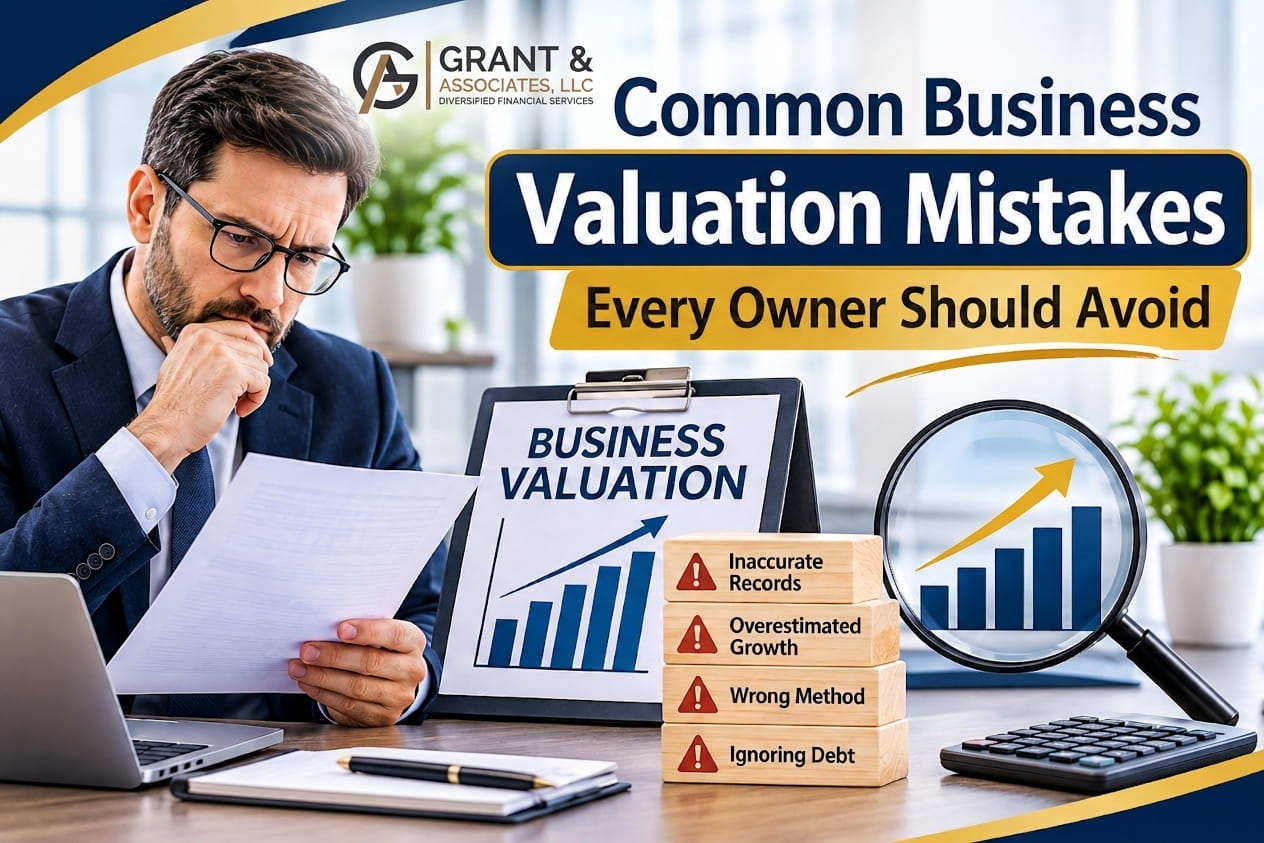
A business valuation can influence some of the most important decisions an owner makes. However, arriving at a reliable figure requires more than looking at annual revenue or adding up business assets. Professional business valuation services examine financial performance, market conditions, future earning potential, and other factors that influence what a business is worth.
Small business owners can easily overlook common business valuation mistakes that affect the final estimate. Inaccurate records, unrealistic growth expectations, and unsuitable valuation methods can all lead to misleading results.
6 Common Business Valuation Mistakes
Here’s an in-depth guide on the topic so you know what not to repeat:
1. Treating Revenue Like the Whole Story
One of the most common mistakes in business valuation is assuming that a company’s revenue tells the complete story of its financial worth. Strong sales figures may look impressive, but they do not necessarily indicate that a business is profitable, financially stable, or attractive to potential buyers.
Consider two small businesses generating $1 million in annual revenue. The first maintains healthy profit margins, collects payments on time, and has manageable operating expenses. The second has high overhead, outstanding customer balances, and significant debt. Despite generating similar revenue, their financial positions are very different. A reliable valuation examines profitability, operating expenses, cash flow, liabilities, and the consistency of earnings. It also considers whether the business can maintain its performance without depending entirely on its current owner.
What to do instead: Review several years of financial performance rather than relying on a single revenue figure. Look at gross profit, operating income, net income, cash flow, and outstanding obligations. These details provide a more complete picture of the company’s financial condition.
2. Letting Messy Financial Records Tell the Wrong Story
Financial statements are among the most important sources of information during a business valuation. If the underlying records contain errors, omissions, or inconsistent classifications, the valuation professional may struggle to determine the company’s actual financial position.
Common business valuation mistakes often begin with bookkeeping problems that owners have overlooked for months or even years. Personal purchases mixed with business expenses, unreconciled bank accounts, missing invoices, and incorrectly recorded transactions can distort reported earnings.
For example, an expense recorded twice may reduce reported profit unnecessarily. On the other hand, unrecorded liabilities can make the business appear financially stronger than it actually is. These financial errors in business valuation can affect income-based calculations, asset assessments, and the information used to compare the company with similar businesses.
Owners should review their balance sheets, income statements, cash flow statements, tax returns, and supporting documentation before beginning the process. Bank reconciliations and accounts receivable and payable records also deserve attention. We have explained several recordkeeping issues in our article, Common Bookkeeping Mistakes That Cost You Money. Addressing these problems before requesting a valuation can make the financial review more straightforward.
What to do instead: Organize financial statements for multiple years, reconcile business accounts, maintain supporting documentation, and correct known discrepancies. If your records have fallen behind, consider working with an accounting professional before proceeding.
3. Choosing a Valuation Method Because It Looks Convenient
Not every business can be valued using the same approach. One of the more significant mistakes in business valuation methods is selecting a calculation simply because it is familiar or easy to apply.
Three generally accepted valuation approaches are commonly considered:
- Income approach: Estimates value based on the business’s expected future economic benefits, such as earnings or cash flow.
- Market approach: Uses information from comparable businesses or transactions to develop an indication of value.
- Asset-based approach: Examines the value of business assets and liabilities to determine the value of the business interest.
Each approach has different applications. An established service company with consistent earnings may be better evaluated using an income-based method. A business with substantial equipment, property, or other valuable assets may require closer attention to its asset base.
The market approach can also provide useful insight, but comparable businesses must be selected carefully. Differences in size, industry, profitability, location, and operating risk can make a seemingly similar company an unsuitable comparison. A frequent error is applying one method without considering whether it reflects the business’s actual circumstances. Some owners also rely entirely on industry rules of thumb or revenue multiples without examining the assumptions behind them.
For a closer look at how these considerations apply to smaller companies, read our guide, A Complete Guide to Small Business Valuation in Maryland.
What to do instead: Consider the income, market, and asset-based approaches where relevant. The valuation professional should explain why particular methods were selected and how the available information supports the conclusion. The objective is not to use every method automatically but to identify the approaches that best reflect the business being valued.

4. Turning Future Projections Into Guaranteed Results
Business owners naturally feel optimistic about their company’s future. They may expect new contracts, expanding customer demand, additional locations, or improved profit margins. These plans can support future growth, but they should not automatically be treated as established financial performance.
Overestimating future earnings is one of the more consequential small business valuation errors. A projection based on a possible contract, an unapproved expansion, or an anticipated increase in sales can inflate the estimated value if its assumptions are not examined carefully.
For instance, a contractor may expect to double annual revenue after hiring another crew. However, the business may not yet have enough confirmed projects, available employees, or working capital to support that growth. A valuation should distinguish between historical results, current operating conditions, and reasonable expectations about future performance. It should also consider the risks associated with achieving projected results.
What to do instead: Prepare financial forecasts using realistic assumptions supported by historical performance, existing contracts, market conditions, and operational capacity. Document the reasoning behind expected revenue growth, expenses, and profit margins. Avoid treating best-case scenarios as the most likely outcome.
5. Forgetting That the Owner May Be Part of the Problem
Many small businesses depend heavily on their owners. The owner may manage important customer relationships, supervise employees, negotiate contracts, approve expenses, and handle daily operations. This arrangement can work well while the owner remains involved. However, it may create concerns for a potential buyer who expects the business to operate independently after the sale.
Ignoring owner dependence is one of the errors in determining business value that can affect the final assessment. If the company relies on one person’s experience, relationships, or specialized knowledge, a buyer may face additional costs and risks when taking over.
Owner compensation also requires careful consideration. Some owners pay themselves above or below what the business would typically pay someone performing the same role. Personal expenses or nonrecurring costs may also appear in the company’s financial statements.
A valuation professional may examine appropriate adjustments to reported earnings to reflect normal operating conditions. These adjustments should be supported by documentation and should not simply remove expenses because the owner considers them unnecessary.
What to do instead: Document important processes, establish clear management responsibilities, develop employee capabilities, and maintain customer relationships across the organization. Review owner compensation and discretionary expenses using reasonable, supportable assumptions.
6. Ignoring Debt, Working Capital, and Hidden Obligations
A business may own valuable equipment, maintain strong sales, and report healthy profits while still carrying significant financial obligations. Overlooking these commitments can create serious business valuation calculation mistakes. Outstanding loans, unpaid taxes, accounts payable, lease obligations, pending legal claims, and other liabilities may affect the value of the business or the amount an owner receives from a transaction.
Working capital also deserves attention. A company needs sufficient short-term resources to manage routine expenses, pay suppliers, and maintain operations. A business that consistently struggles to collect receivables may have a different financial risk profile from one with reliable payment cycles.
Owners should also understand the distinction between enterprise value and equity value. Enterprise value generally reflects the value of the operating business before certain financing-related adjustments, while equity value represents the value attributable to owners after accounting for relevant debt and other adjustments. The precise treatment depends on the valuation and transaction terms.
What to do instead: Review all outstanding liabilities, debt agreements, accounts payable, receivables, lease commitments, and other financial obligations. Make sure the valuation clearly identifies what is included and how debt, cash, and working capital have been treated.
Build a More Reliable Picture of Your Business’s Worth
Avoiding mistakes during a business valuation starts with accurate financial records, realistic expectations, and a clear understanding of what influences business value. From selecting suitable valuation methods to identifying intangible assets and reviewing outstanding liabilities, every detail contributes to a more meaningful assessment.
Small business owners should approach the process as an opportunity to understand their company’s financial position, not simply as a way to arrive at a number. Professional guidance can help identify overlooked factors, evaluate financial information, and support decisions involving ownership transitions, business sales, and long-term planning.
Grant & Associates, LLC provides reliable services to help business owners make informed financial decisions. If you are considering a valuation or want a clearer understanding of your company’s financial worth, contact us for a free consultation.
Frequently asked questions
Q.01What Is The Single Biggest Mistake Small Businesses Make?
Relying on inaccurate or incomplete financial information is one of the biggest mistakes. If revenue, expenses, liabilities, and cash flow are not recorded correctly, the valuation may not reflect the company’s actual financial condition.
Q.02What Are The Common Mistakes In Business Valuation?
Common mistakes include relying only on revenue, using inaccurate financial statements, selecting unsuitable valuation methods, overestimating future earnings, overlooking goodwill, and ignoring debt or other liabilities. Each can affect the reliability of the final estimate.
Q.03How Can Business Owners Avoid Valuation Mistakes?
Owners can reduce valuation errors by maintaining accurate financial records, reviewing several years of performance, preparing realistic forecasts, documenting business assets and liabilities, and working with qualified valuation professionals. They should also establish the purpose and effective date of the valuation.
Q.04What Is The Biggest Mistake When Valuing A Small Business?
One major mistake is assuming that a business’s revenue or asking price represents its actual value. Profitability, cash flow, customer relationships, management structure, liabilities, and market conditions all influence what a business may be worth.
Q.05Can Inaccurate Financial Statements Affect Business Valuation?
Yes. Inaccurate financial statements can distort reported earnings, asset values, liabilities, and cash flow. These problems can lead to unreliable calculations and make it difficult for a valuation professional to reach a well-supported conclusion. Correcting known discrepancies and providing supporting records helps improve the assessment.
About the author
Robert E. Grant
Founder, Grant & Associates, LLC
Robert has helped Maryland business owners and families with accounting, payroll and tax since 1994. He writes in plain English about what to do, what to avoid, and when to call for help, drawing on three decades of real client files.