

Selling a business can turn years of hard work into a significant financial return, but the taxes involved can affect how much money you actually walk away with. From federal income taxes to Maryland tax on business sale, the financial consequences of selling a business depend on how the transaction is structured, what assets are included, and how much profit the sale generates. Planning ahead can help business owners avoid unexpected liabilities and make more informed decisions.
For Maryland business owners preparing for an exit, tax preparation services can help identify potential tax liabilities, review financial records, and evaluate options before finalizing a deal. Understanding the tax implications of selling a business is especially important if you’re selling a small business, transferring ownership to another party, or retiring after years of operating a company.
This guide explains the Maryland tax on business sale proceeds, how capital gains are handled, what asset sales may trigger, and which federal and state reporting requirements owners should keep in mind.
How Is a Business Sale Taxed in Maryland?
The tax consequences of selling a business in Maryland depend largely on the type of transaction. Owners may sell individual business assets, transfer their ownership interest in a company, or negotiate a deal involving a combination of assets and liabilities. Each approach can produce different tax outcomes.
Maryland does not impose a separate, flat tax specifically on the act of selling a business. Instead, sellers may face state income taxes on taxable gains, local income taxes, applicable federal taxes, and sales and use taxes on certain transferred assets. The transaction’s structure, the assets involved, and the seller’s individual tax circumstances all influence the final tax bill.
Asset Sale vs. Ownership Sale
An asset sale involves transferring specific assets that belong to the business. These may include equipment, inventory, furniture, intellectual property, customer lists, goodwill, and other items. The seller retains the legal business entity, although the business itself may cease operating after the transaction.
An ownership sale involves transferring shares of a corporation or an ownership interest in a partnership or LLC, depending on how the entity is structured. The buyer acquires the ownership interest rather than purchasing each business asset individually.
Maryland Capital Gains Tax on Business Sale
Maryland tax on business sale generally taxes capital gains as part of income under its regular income tax system rather than using a separate, lower capital gains rate. For individual taxpayers, Maryland also enacted an additional 2% tax on qualifying net capital gains for tax years beginning in 2025, subject to a federal adjusted gross income threshold established by law. This surtax may affect qualifying gains from business sales.
How Capital Gains Are Calculated
A capital gain generally represents the difference between the amount realized from a sale and the asset’s adjusted basis, after accounting for applicable transaction costs and tax rules.
For example, suppose a business owner sells an ownership interest for $500,000, with an adjusted basis of $150,000. Assuming no additional adjustments, the resulting gain would be $350,000.
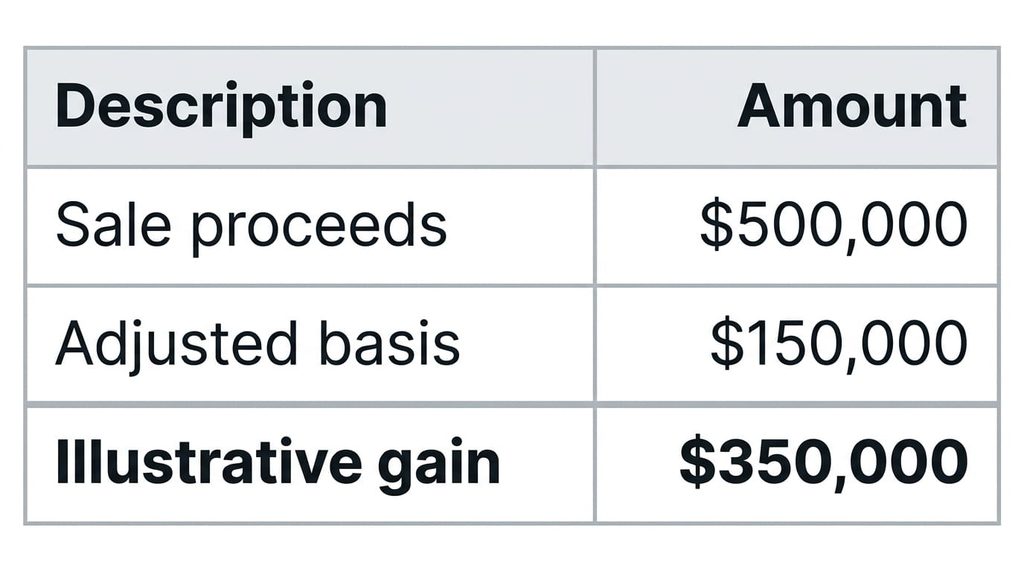
The $350,000 gain is not necessarily taxed at one rate. Federal and Maryland rules, holding periods, the nature of the asset, deductions, other income, and applicable surtaxes can affect the amount ultimately owed.
Maryland Business Asset Sale Tax

An asset sale may trigger Maryland sales and use tax, even if the seller is primarily concerned with income taxes. Maryland generally imposes a 6% sales and use tax on taxable tangible personal property and certain digital products transferred as part of a business purchase, unless an exemption applies.
The tax treatment of individual assets may vary. For example:
- Equipment and furniture: Machinery, office furniture, fixtures, and similar tangible property may be subject to sales and use tax.
- Inventory: Inventory transferred for resale may qualify for an exemption, depending on the transaction and applicable requirements.
- Goodwill: Goodwill generally is not treated like taxable tangible personal property for Maryland sales tax purposes.
- Digital products: Certain digital products transferred as part of a business acquisition may be taxable.
- Real estate: Real property is not generally subject to sales tax, although transfer and recordation taxes may apply when real estate is included in the transaction.
Federal Tax Implications of Selling a Business
Maryland business owners must also account for federal taxes when selling a company. The IRS generally treats a business asset sale as the sale of separate assets rather than a single transaction for tax purposes. Each asset may have its own tax treatment depending on its classification, adjusted basis, and holding period.
Some of the most common categories include:
- Capital assets: Certain assets may produce capital gains or losses when sold.
- Depreciable business property: Selling equipment, vehicles, or other depreciated property may result in depreciation recapture or other ordinary income treatment, depending on the applicable rules.
- Inventory: Inventory sold as part of a transaction generally produces ordinary business income rather than capital gains.
- Goodwill: Goodwill may qualify for capital gain treatment in an asset sale, subject to the applicable rules and allocation.
- Accounts receivable: Receivables may generate ordinary income depending on the seller’s accounting method and the transaction’s structure.
Reporting a Business Sale to the IRS
Business sales generally must be reported to the IRS. The reporting requirements depend on the business structure, the assets sold, and the transaction’s tax treatment. For a qualifying sale of a group of business assets, both the buyer and seller generally must file Form 8594, Asset Acquisition Statement Under Section 1060, with their federal income tax returns for the year of the sale. This form reports how the purchase price is allocated among the transferred assets.
Other forms may be required depending on the transaction:
- Form 4797: Used to report gains or losses from certain sales of business property.
- Schedule D: Used to report capital gains and losses when applicable.
- Form 8949: Used to report certain capital asset transactions.
- Final business tax return: Required when the business closes or terminates, depending on its entity type.
Sales Tax Responsibilities Before and During a Business Sale
Business owners must also keep up with their regular sales tax responsibilities while preparing to sell. If you’re operating a business in Maryland, you generally must collect sales tax on taxable sales, register where required, file returns, and remit the tax collected according to your assigned filing schedule.
Maryland’s general sales tax rate is 6%, although specific transactions may be subject to different rules or exemptions. Businesses can file and pay sales tax through Maryland Tax Connect, the Comptroller’s online portal. When a business is sold, however, the sales tax obligations associated with transferring assets are separate from routine sales tax responsibilities. A buyer may owe sales and use tax on qualifying assets purchased as part of the transaction.
What to Do Before Selling Your Business in Maryland
Planning ahead can help business owners better understand their tax exposure, negotiate more effectively, and avoid problems during due diligence. Here are several steps worth taking before putting your business on the market:
- Review your financial records: Make sure your financial statements, tax returns, asset records, and bookkeeping information are accurate and up to date.
- Get a business valuation: A professional valuation can help you understand what your business may be worth and support negotiations with potential buyers. Read our A Complete Guide to Small Business Valuation in Maryland for more information.
- Evaluate the deal structure: Consider whether an asset sale or ownership sale makes sense for your circumstances. The structure can influence your federal, state, and local tax liabilities.
- Estimate your tax liability: Calculate potential federal, Maryland, county, and transaction-related taxes before agreeing to the final terms.
- Plan ahead for tax obligations: Our guide on Quarterly Tax Planning Tips for Maryland Business Owners explains how proactive tax planning can help businesses stay prepared for financial obligations.
- Consult a CPA: A CPA can review your transaction, assess potential tax consequences, and help you prepare the necessary tax filings.
Prepare for Your Business Sale with Professional Tax Guidance
The small business sale tax consequences can vary considerably depending on the transaction’s structure, the assets involved, and the owner’s financial circumstances. From capital gains and income taxes to sales and use tax on certain business assets, business owners should understand their obligations before completing a transaction.
Grant & Associates, LLC’s experienced team can help you review your financial position, evaluate tax considerations, and prepare for the financial responsibilities associated with selling your business.
Frequently asked questions
Q.01What Should Maryland Business Owners Know Before Selling?
Maryland business owners should review their financial records, obtain a business valuation, understand potential federal and state tax liabilities, and decide whether an asset sale or ownership sale makes sense. Preparing these details ahead of time can help avoid closing delays and unexpected tax obligations.
Q.02What Taxes Do I Pay When Selling A Business In Maryland?
Business sellers may owe federal income tax, Maryland state income tax, county income tax, and sales and use tax on certain transferred assets. The amount depends on the transaction structure, taxable gain, asset allocation, and the seller’s tax circumstances.
Q.03Is Selling A Small Business Considered A Capital Gain?
Some proceeds from selling a small business may qualify as capital gains, but the entire sale isn’t necessarily taxed that way. Inventory, depreciated equipment, accounts receivable, and other assets may generate ordinary income or different tax treatment depending on the transaction.
Q.04Do I Have To Report The Sale Of My Business To The IRS?
Yes. Business sales generally must be reported to the IRS. Depending on the transaction, sellers may need to file Form 8594, Form 4797, Schedule D, or other applicable forms to report the proceeds and resulting gains or losses.
Q.05How to pay sales tax as a small business owner?
Maryland small business owners can file and pay sales tax through Maryland Tax Connect, the Comptroller’s online portal. Businesses must collect sales tax on taxable sales, file returns according to their assigned schedule, and remit collected tax by the applicable due date.
About the author
Robert E. Grant
Founder, Grant & Associates, LLC
Robert has helped Maryland business owners and families with accounting, payroll and tax since 1994. He writes in plain English about what to do, what to avoid, and when to call for help, drawing on three decades of real client files.